JC Lucas ERPNext / PRAI Systems
Useful AI starts with
clear boundaries.
An ERPNext implementation for JC Lucas, paired with an internal AI integration layer that keeps business permissions and human confirmation in control.
The workflow comes first.
Business software has to represent the way work actually moves. A quotation becomes a job; revisions need evidence; payments and quality checks affect what can happen next. An assistant is only useful if it respects those rules.
I extended ERPNext with company-specific configuration for JC Lucas and built a separate internal AI integration. My ownership spans application development, configuration, infrastructure, and verification. ERPNext provides the foundation; the project is an implementation and extension of that platform.
What I built.
- Versioned configuration for quotation review, job handoffs, evidence and revision tracking, payment gates, production, quality control, reminders, and bill-of-materials workflows.
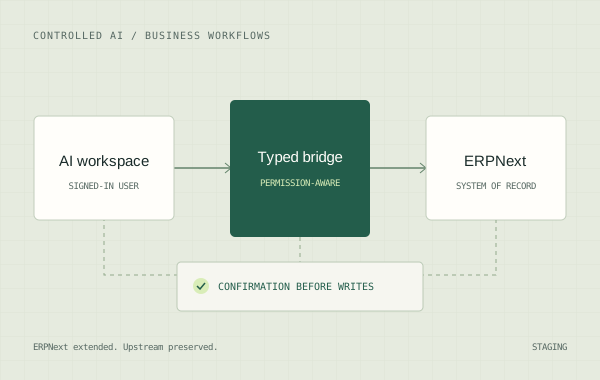
- A custom AI wrapper connected to ERPNext through a typed, authenticated bridge.
- Containerized services using Docker, staging infrastructure on DigitalOcean, and domain management through Cloudflare.
The decisions that matter.
Keep the agent outside the credential boundary.
The agent does not receive ERPNext credentials. It requests operations through a controlled bridge, where approved document types and the signed-in user’s permissions constrain what can happen.
Make a write an explicit decision.
Changes require confirmation. This makes the transition from an assistant’s proposed action to a business-system write visible, instead of giving conversational output unrestricted authority.
Preserve the upstream systems.
The wrapper and company configuration are maintained separately from the upstream software. This keeps custom business behavior identifiable and makes the boundary between the platform and the implementation easier to review.
Verification before release.
The repository includes a live smoke-test script covering service health, exposed toolsets, session binding, and an audited read through the assistant integration. A separate isolation checklist covers cross-instance access rejection, resource separation, and persistence after a restart.
The focus is on the behavior that matters at the boundary: which operations are allowed, who authorizes them, and when a requested change can proceed. The implementation remains subject to staging verification and release review.
Where the project stands.
In staging
The JC Lucas ERPNext implementation is in staging. The AI layer is an internal integration and is separate from the client deliverables. Production rollout and operational acceptance are not claimed here.
This project brings together business-process modeling, applied AI, access control, and infrastructure ownership—the connected engineering work I enjoy.
Keep exploring
Screen
Let’s build something useful
A good problem.
A thoughtful solution.
Exploring software engineering, applied AI, and product engineering opportunities with teams around the world.
Based in Quezon City, Philippines · UTC+8